

Septuaginta
Greek Translation of the Hebrew Old Testament

The research that was carried out by the Göttingen Septuaginta Project (1908–2015) focused on one of the most important and influential writings in world literature: the Greek translation of the Hebrew Bible. Legend has it that in the third century BCE, seventy-two wise men translated the Jewish Torah into Greek in a period of seventy-two days. In accordance with this story, the translation that was produced was aptly called Septuagint (‘the Seventy’). In reality, the translation project took over three centuries to be completed, and continued well into the first century CE. Throughout its subsequent history, the Septuagint was revised and reworked several times by both Jews and Christians (resulting in so-called recensions of the Greek text).
The Göttingen Septuaginta Project had set itself the task of reconstructing – in the form of a critical edition – the earliest form of the text that can be reasonably reconstructed, that is: a text that precedes all recensions. In doing so, it also aimed to document all alterations in an apparatus that accompanied the critical text. For over a century, generations of scholars had dedicated themselves to this massive undertaking.
During the runtime of the Septuaginta Project, two-thirds of this critical edition were published. Further editorial work was undertaken by a research commission from 2016 to 2019 and has since been overseen by the Robert Hanhart Foundation for the Promotion of Septuagint Research. Since 2020, the Psalter has been edited as part of its own dedicated Academies’ Project.
History

The idea of establishing the Göttingen Septuaginta Project is rooted in the historical-philosophical tradition of the 19th century. Being part of this tradition, Paul Anton de Lagarde (1827–1891) postulated that history could only be fully appreciated through the preservation of our religious heritage in the form of critical editions. Although Lagarde’s (ideological) intentions were highly questionable, it was his life commitment to this claim that brought him to establish a project of reconstructing and publishing the original text of the Septuagint and to sow the seeds of the Project.
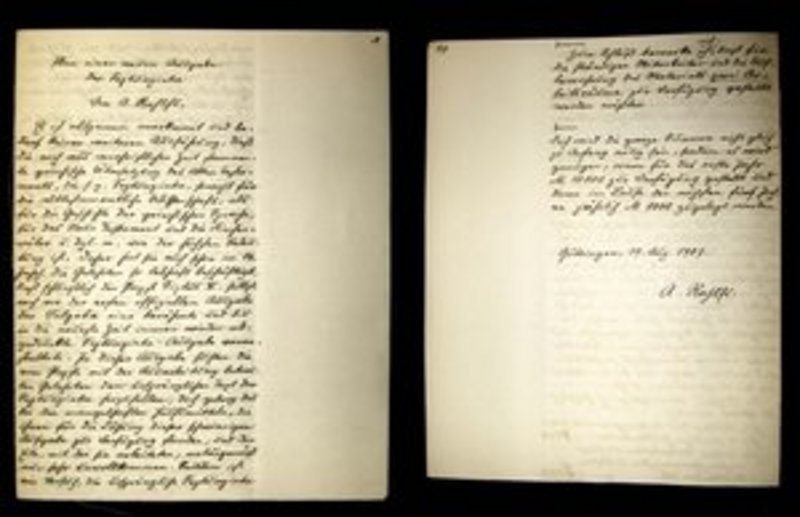
When, after extensive spadework, Lagarde finally “came to rest”—as his successor Julius Wellhausen (1844–1918) put it—, it was left to his sole pupil Alfred Rahlfs (1865–1935), together with the Göttingen Old Testament scholar Rudolf Smend (1851–1913), to undertake the first step towards the foundation of the Göttingen Septuaginta Project. He did so by writing a memorandum dated 19 August 1907 and addressed to the Prussian Ministry of Religious, Educational and Medical Affairs (Preußisches Ministerium der Geistlichen, Unterrichts- und Medicinalangelegenheiten). Intensively promoted by prominent Göttingen scholars and backed by the Royal Academy of Sciences of Berlin, the Septuaginta Project could be launched on 1 April 1908 as an institution governed by the Royal Society (today: Academy) of Sciences and Humanities of Göttingen. The Prussian Ministry and, from 1911 onwards, the Government of the German Empire provided financial security for the institution.
The names of the men who played a crucial role in the process of founding and developing the Septuaginta Project are illustrious. They impersonate an approach that was truly interdisciplinary in the modern sense of the word: operating within the methodological framework of Greek philology, they combined in their Septuagint research linguistics, Old and New Testament studies, as well as expertise in the field of patristic studies. Alongside Friedrich Leo (1851–1914) and Paul Wendland (1864–1915), two classical philologists who spared no efforts to promote the Septuaginta Project, it was primarily Eduard Schwartz (1858–1940) who played a huge part in shaping the work of the institution. With very precise notes and memoranda he outlined the specific steps and difficulties of the mammoth project that was to be undertaken. The detailed character of this survey stands in sharp contrast with Rahlfs’ original plans (and prognoses, according to which he estimated in 1907 that “the enterprise will take 30 years…”). Also the Old Testament scholars Wellhausen and Smend, the linguist Jacob Wackernagel (1853–1938), and the patristic scholar Nathanael Bonwetsch (1848–1925) feature among the institution’s founding fathers. Early interdisciplinarity is also reflected in the fact that throughout the history of the Septuaginta Project, which spans more than a century, the chairs of the executive committee have been held by classical philologists (Schwartz, 1908–1909; Kurt Latte, 1952–1956), linguists (Wackernagel, 1909–1915), Old Testament scholars (Alfred Bertholet, 1915–1928; Walter Zimmerli, 1970–1979; Rudolf Smend, 1979–2001; Reinhard Gregor Kratz, since 2001) and New Testament scholars (Walter Bauer, 1928–1946; Joachim Jeremias, 1956–1970).
The following passage from one of the early memoranda (1909) of the committee gives the impression that the interdisciplinarity that characterised the early research of the institute occasionally collided with certain restrictions of confessional and national nature:
“The entire Christian world as well as philological and historical scholarship is greatly interested in the task of reconstructing the original Septuagint, but this task can only be undertaken by German philologists and only on Protestant soil.”

Even back then, however, the emphatic reference to Protestantism met a mixed response among the committee members. Moreover, the international correspondence produced by Rahlfs in his function as the first director of the institution (1908–1933) clearly demonstrates how much the Göttingen edition project was designed for international cooperation, even in its early stages. It was the Catholic Bible scholar Joseph Ziegler whose edition of the prophetic books (1939–1957) shaped the first phase of the Göttingen editio maior and who helped the project to shake off the last confessional constraints.
The international character was fully established in 1966 with the appointment of the Canadian Professor of Oriental Studies and Old Testament John William Wevers. His edition of the Pentateuch (1974–1991) characterises the second publication phase, together with the editions of the deuterocanonical books by Robert Hanhart, the longstanding director of the Septuaginta Project (1961–1993). A further expansion took place with the appointment of the Septuagint scholar Anneli Aejmelaeus, a member of the so-called Helsinki School, as director in the years 1993–2000.
The interconfessional, interreligious and international orientation of the Göttingen Septuaginta Project is most clearly visible in its subject matter: the Greek translation of the Hebrew Bible, which was produced by Jews in the Alexandrine diaspora and later became part of Christian Scripture.
Working Methods and Tasks


The Septuaginta Project took on as its central tasks the preparation of the editions through collation and revision of the manuscripts, supporting the volunteer editors during the editing phase, and overseeing the submitted manuscripts throughout the printing process. In addition, the “Verzeichnis der griechischen Handschriften des Alten Testaments” (Catalogue of Greek Manuscripts of the Old Testament, MSU 2), originally compiled by Alfred Rahlfs in 1914, was revised, and the so-called Rahlfs sigla were assigned and managed.
The collation of the manuscripts was carried out by student assistants under academic supervision and was based on the principle of completeness: all variants, errors, and orthographic peculiarities were recorded and entered by hand into specially prepared collation booklets of 150 to 200 pages.
Since the ongoing collation work focused exclusively on the Psalter—the book with the highest manuscript density in the Septuagint tradition—and the work had begun quite some time ago (from 1996 onward), retroactive digitisation was not undertaken.
The collations were followed by revisions: each manuscript was reviewed a second time, and all entries were checked again. This time-consuming process was necessary, firstly, to eliminate collation errors that had arisen due to varying reading skills among the collators or because of difficult-to-read parts of the manuscripts, such as tachygraphies, damage, fading ink, or poor reproductions. Secondly, it aimed to standardise and correct unclear or cumbersome notations so that the editors, who themselves only worked directly with the manuscripts in exceptional cases, could best understand the findings recorded in the collation booklets. Only after this process did the editors receive the completed collation booklets as the basis for their editions.
Publications
Within the body of publications produced by the Septuaginta Project, one can distinguish between editions and studies. The series of editions is entitled Septuaginta. Vetus Testamentum Graecum auctoritate Academiae Scientiarum Gottingensis editum. At present, it comprises 24 volumes—which adds up to about two thirds of the complete Septuagint corpus. In 2004, a supplementary series to the edition was launched with the first volume of D. Fraenkel’s revised edition of A. Rahlfs’ Verzeichnis der griechischen Handschriften des Alten Testaments.
Scholarly research on textual criticism and the transmission history of the Septuagint is published in the series Mitteilungen des Septuaginta-Unternehmens (MSU). This collective title is used to gather studies that are published in the Nachrichten der Akademie der Wissenschaften in Göttingen I. Phil.-hist. Klasse (in the case of shorter studies), and in the Abhandlungen der Akademie der Wissenschaften I. Phil.-hist. Klasse (for monographs).
Under the overall title Mitteilungen des Septuaginta-Unternehmens (MSU), studies primarily focused on the field of text and transmission history, a total of 30 volumes were published by 2015.
Publications up to 2015:
- Septuaginta Vetus Testamentum Graecum (Vol I - Vol XVI,2)
- Supplementum (Vol I,1)
- Mitteilungen des Septuaginta-Unternehmens (MSU, Vol 1,1 - Vol 30)
- Benutzerhandbuch (Vol 1 and 2)
Publications 2016 to 2019 (Commission for the Edition and Research of the Septuagint)
Septuaginta Vetus Testamentum Graecum auctoritate Academiae Scientiarum Gottingensis editum
- Sapientia Iesu Filii Sirach, edidit Joseph Ziegler. Septuaginta vol. XII,2, Göttingen, 3. Auflage 2016.
- Esdrae liber II, edidit Robert Hanhart. Septuaginta vol. VIII,2, Göttingen, 2. Auflage 2017.
- Maccabaeorum liber II, copiis usus quas reliquit Werner Kappler edidit Robert Hanhart. Septuaginta vol. IX,2, Göttingen, 4. Auflage 2017.
- Sapientia Salomonis, edidit Joseph Ziegler. Septuaginta vol. XII,1, Göttingen, 3. Auflage 2017.
- Psalmi Salomonis, edidit Felix Albrecht. Septuaginta vol. XII,3, Göttingen 2018.
- Ecclesiastes, edidit Peter John Gentry. Septuaginta vol. XI,2, Göttingen 2019.
Since 2020:
Since January 1, 2020, the Robert Hanhart Foundation for the Promotion of Septuagint Research has been entrusted with the editorial backlog of the former Septuaginta Project. The undertaking is being continued within the Academies' Project "Editio critica maior of the Greek Psalter."
Holdings, Sigla, and Resources

Library of the Septuaginta Project
The Septuaginta Project has a research library comprising several thousand volumes, whose valuable collection of printed editions, sources, reference works, and in part extremely rare specialised literature is continuously expanded through new acquisitions in both print and electronic form. The holdings of the library are fully cataloged in the Göttingen University Catalogue (GUK).
Library holdings:
Signaturenbereich 1–35: Textausgaben der LXX und ihrer Versionen
Signaturenbereich 36–64: Septuaginta-Studien
Signaturenbereich 65–124: Kommentare und Zeitschriften
Signaturenbereich 125–154: Hilfswissenschaften
Signaturenbereich 155–162: Moderne Sprachen
Signaturenbereich 163–190: Äthiopica
Signaturenbereich 191–202: Arabica
Signaturenbereich 203–221: Targumliteratur
Signaturenbereich 222–225: Armenica und Georgica
Signaturenbereich 226–249: wie Bereich 1–35
Signaturenbereich 250–274: wie Bereich 36–64
Signaturenbereich 275–296: Grammatica, griechisch
Signaturenbereich 297–304: Neues Testament
Signaturenbereich 305–321: (hebr.) Altes Testament
Signaturenbereich 322–353: Coptica
Signaturenbereich 354–385: Vetus Latina, Vulgata
Signaturenbereich 386–389: Samaritana
Signaturenbereich 390–391: Slavica
Signaturenbereich 392–438: Syriaca
Signaturenbereich 439–466: Aristeas, Philo, Josephus, Kirchenväter
Signaturenbereich 467–480: Qumran
Signaturenbereich C: Handschriftenkataloge und Instrumenta
Signaturenbereich de Lagarde: Lagardiana
Signaturenbereich Z: Septuaginta-Bibliothek Joseph Zieglers (1902–1988)
Rahlfs Sigla
For working with the Septuagint manuscript evidence, the Septuaginta Project of the Göttingen Academy of Sciences and Humanities of Göttingen designed an official system of sigla, which it kept on expanding whenever necessary (e.g. when new manuscripts were discovered). This system is built on the following tradition and principles (cf. A. Rahlfs, Verzeichnis der griechischen Handschriften des Alten Testaments, Bd. I,1 Die Überlieferung bis zum VIII. Jahrhundert bearbeitet von Detlef Fraenkel, Göttingen 2004, p. XXII–XXIV):
“In developing his system of siglum assignments (1914), A. Rahlfs exhibited how practical a mind he disposed of and how workable his design of the Göttingen project was.
As the ground rule he determined that each manuscript is given an individual and unchangeable siglum, which is kept as simple as possible. In view of the large amount of Septuagint manuscripts, only numbers (and not letters) a priori qualify to be used as sigla. Then again, Rahlfs did take the existing tradition into account, which had already started to identify a handful of famous codices with letters (such as A for codex Alexandrinus). Therefore he selected a small group of manuscripts for which he used letters as sigla, instead of numbers.
As a second cardinal rule he laid down that sigla must not be expanded upon: no exponents or letters should be added. Also to this second rule a legitimate exception was allowed: earlier, E. Tisserant had observed that the palimpsest codex Zuqninensis had been assembled on the basis of six already existing manuscripts. In order to distinguish them, he used the sigla Zi–vi: these where copied by Rahlfs. A second exception resulted from a misunderstanding: after Rahlfs had assigned the siglum W to manuscript Washington (SIL) Ms. I (containing large parts of Deuteronomy and Joshua), J. Ziegler used to same siglum in his edition of the Minor Prophets (Göttingen 1943) to refer to Washington (SIL), Ms. V. Today the siglum WI is used to denote the original codex W.
On the basis of both these ground rules, Rahlfs divided the manuscript evidence into different groups, for each of which he reserved a specific range of sigla.”
Overview of the main groups of Rahlfs sigla:
- group I: sigla A–Z (a selection of uncial codices)
- group II: sigla 13–311 (sigla assigned by Holmes & Parsons)
- group III: sigla 312–800 (manuscripts of Septuagint books with the exception of the Psalter)
- group IV: sigla 801–1000 (smaller fragments of Septuagint books with the exception of the Psalter)
- group V: sigla 1001–‹1400› (Psalter manuscripts up to the 12th century)
- group VI: sigla 1401–‹2000› (younger Psalter manuscripts, including a few of uncertain dating)
- group VII: sigla 2001–‹3000› (smaller fragments of the Psalms up to the 8th century)
- group VIII: sigla 3001–‹5000› (manuscripts of Septuagint books with the exception of the Psalter)
- group IX: sigla 5001–‹7000› (smaller fragments of Septuagint books with the exception of the Psalter)
- group X: sigla 7001ff. (Psalter manuscripts)
Downloads
Old Editions
- Editio Sixtina [H palaia diathk kata tus hebdomkonta, di'authentias Xystu E' Akru Archieres ekdotheisa] (Romae 1587)
- Monumenta sacra inedita / Aenoth. Frideric. Constantinus Tischendorf (Hrsg.); Vol. Primum: Fragmenta sacra palimpsesta (Lipsiae 1855)
Publications by Paul Anton de Lagarde
- Paul Anton de Lagarde, Praetermissorum libri duo (Gottingae 1879)
- Paul Anton de Lagarde, Probe einer neuen Ausgabe der lateinischen übersezungen des alten testaments (Goettingen 1885)
Publications by Alfred Rahlfs
- Alfred Rahlfs (Hg.), Des Gregorius Abulfarag genannt Bar Ebhroyo Anmerkungen zu den salomonischen Schriften (Leipzig 1887) Zugl.: Göttingen, Univ., Diss., 1887.
- Alfred Rahlfs, ʿĀnî und ʿānāw in den Psalmen (Göttingen 1892). Teilw. zugl.: Göttingen, Univ., Theol. Diss., 1891.
- Alfred Rahlfs, Ueber eine von Tischendorf aus dem Orient mitgebrachte, in Oxford, Cambridge, London und Petersburg liegende Handschrift der Septuaginta (Göttingen 1898). Aus: Nachrichten der K. Gesellschaft der Wissenschaft zu Göttingen. Philologisch-historische Klasse; 1898,1.
- Alfred Rahlfs, Alter und Heimat der vaticanischen Bibelhandschrift (Göttingen 1899). Aus: Nachrichten der K. Gesellschaft der Wissenschaft zu Göttingen. Philologisch-historische Klasse; 1899,1.
- Alfred Rahlfs, Die Berliner Handschrift des sahidischen Psalters (Berlin 1901). Abhandlungen der Königlichen Gesellschaft der Wissenschaften zu Göttingen, Philologisch-Historische Klasse; N.F., 4,4.
- Paul Glaue/Alfred Rahlfs, Fragmente einer griechischen Übersetzung des samaritanischen Pentateuch (Berlin 1911). Mitteilungen des Septuaginta-Unternehmens (MSU), Bd. 1,2.
- Wilhelm Gerhäußer/Alfred Rahlfs, Münchener Septuaginta-Fragmente (Berlin 1913). Mitteilungen des Septuaginta-Unternehmens (MSU), Bd. 1,4.
- Alfred Rahlfs, Verzeichnis der griechischen Handschriften des Alten Testaments (Berlin 1914). Mitteilungen des Septuaginta-Unternehmens (MSU), Bd. 2.
- Leonhard Lütkemann/Alfred Rahlfs, Hexaplarische Randnoten zu Isaias 1–16, aus einer Sinai-Handschrift (Berlin 1915). Mitteilungen des Septuaginta-Unternehmens (MSU), Bd. 1,6.
- Alfred Rahlfs, Die alttestamentlichen Lektionen der griechischen Kirche (Berlin 1915). Mitteilungen des Septuaginta-Unternehmens (MSU), Bd. 1,5.
- Alfred Rahlfs, Kleine Mitteilungen aus dem Septuaginta-Unternehmen (Berlin 1915). Mitteilungen des Septuaginta-Unternehmens (MSU), Bd. 1,7.
- Alfred Rahlfs, Nissel und Petraeus, ihre äthiopischen Textausgaben und Typen (Göttingen 1917). Aus: Nachrichten von der K. Gesellschaft der Wissenschaft zu Göttingen. Philologisch-historische Klasse; 1917.
- Alfred Rahlfs, Über einige alttestamentliche Handschriften des Abessinierklosters S. Stefano zu Rom (Berlin 1918). Mitteilungen des Septuaginta-Unternehmens (MSU), Bd. 3,1.
- Alfred Rahlfs, Studie über den griechischen Text des Buches Ruth (Berlin 1922). Mitteilungen des Septuaginta-Unternehmens der Königlichen Gesellschaft der Wissenschaften zu Göttingen 3,2. Auch als: Nachrichten von der K. Gesellschaft der Wissenschaften zu Göttingen, Philologisch-Historische Klasse; 1922.
- Alfred Rahlfs, Paul de Lagardes wissenschaftliches Lebenswerk im Rahmen einer Geschichte seines Lebens dargestellt (Berlin 1928). Mitteilungen des Septuaginta-Unternehmens (MSU), Bd. 4.
Mitteilungen des Septuaginta-Unternehmens (MSU)
- Volume 30: R. G. Kratz/B. Neuschäfer (Hg.), Die Göttinger Septuaginta. Ein editorisches Jahrhundertprojekt, Berlin/Boston 2013. Order here
- Volume 29: O. Wahl, Die Sacra-Parallela-Zitate aus den Büchern Josua, Richter, 1/2 Samuel, 3/4 Könige sowie 1/2 Chronik, Göttingen 2004. Order here
- Volume 28: C. J. Wagner, Polyglotte Tobit-Synopse. Griechisch-Lateinisch-Syrisch-Hebräisch-Aramäisch, Göttingen 2003. Order here
- Volume 27: F. Austermann, Von der Tora zum Nomos. Untersuchungen zur Übersetzungsweise und Interpretation im Septuaginta-Psalter, Göttingen 2003. Order here
- Volume 26: J. W. Wevers/D. Fraenkel, Studies in the Text Histories of Deuteronomy and Ezekiel, Göttingen 2003. Order here
- Volume 25: R. Hanhart, Text und Textgeschichte des 2. Esrabuches, Göttingen 2003. Order here; PDF-Download
- Volume 24: A. Aejmelaeus/U. Quast (Hg.), Der Septuaginta-Psalter und seine Tochterübersetzungen. Symposium in Göttingen 1997, Göttingen 2000. Order here
- Volume 23: O. Wahl, Der Deuteronomium-Text der Sacra Parallela, Göttingen 1997. PDF-Download
- Volume 22: R. Hanhart, Ein unbekannter Text zur griechischen Esra-Überlieferung, Göttingen 1995. PDF-Download
- Volume 21: J. W. Wevers, Text History of the Greek Exodus, Göttingen 1992. PDF-Download
- Volume 20: D. Fraenkel/J. W. Wevers/U. Quast (Hg.), Studien zur Septuaginta – Robert Hanhart zu Ehren. Aus Anlaß seines 65. Geburtstages, Göttingen 1990. [Derzeit nicht lieferbar.]
- Volume 19: J. W. Wevers, Text History of the Greek Leviticus, Göttingen 1986. Order here; PDF-Download
- Volume 18: J. Ziegler, Beiträge zum griechischen Iob, Göttingen 1985. Order here
- Volume 17: R. Hanhart, Text und Textgeschichte des Buches Tobit, Göttingen 1984. Order here; PDF-Download
- Volume 16: J. W. Wevers, Text History of the Greek Numbers, Göttingen 1982. Order here; PDF-Download
- Volume 15: J. Barr, The Typology of Literalism in Ancient Biblical Translations, Göttingen 1979. PDF-Download
- Volume 14: R. Hanhart, Text und Textgeschichte des Buches Judith, Göttingen 1979. Order here; PDF-Download
- Volume 13: J. W. Wevers, Text History of the Greek Deuteronomy, Göttingen 1978. Order here; PDF-Download
- Volume 12: R. Hanhart, Text und Textgeschichte des 1. Esrabuches, Göttingen 1974. PDF-Download
- Volume 11: J. W. Wevers, Text History of the Greek Genesis, Göttingen 1974. Order here; PDF-Download
- Volume 10: J. Ziegler, Sylloge, Göttingen 1971. [Derzeit nicht lieferbar.]
- Volume 9: A. Schmitt, Stammt der sogenannte „θ´“-Text bei Daniel wirklich von Theodotion?, Göttingen 1966. PDF-Download
- Volume 8: K. Treu, Majuskelbruchstücke der Septuaginta aus Damaskus, Göttingen 1966. [Derzeit nicht lieferbar.]
- Volume 7: R. Hanhart, Zum Text des 2. und 3. Makkabäerbuches, Göttingen 1961. PDF-Download
- Volume 6: J. Ziegler, Beiträge zur Ieremias-Septuaginta, Göttingen 1958. [Derzeit nicht lieferbar.]
- Volume 5: A. Möhle, Theodoret von Kyros. Kommentar zu Jesaia, Berlin 1932. [Derzeit nicht lieferbar.]
- Volume 4: A. Rahlfs, Paul de Lagardes wissenschaftliches Lebenswerk im Rahmen einer Geschichte seines Lebens dargestellt, Berlin 1928. PDF-Download
- Volume 3,3: M. Johannessohn, Der Gebrauch der Präpositionen in der Septuaginta, Berlin 1926. [Derzeit nicht lieferbar.]
- Volume 3,2: A. Rahlfs, Studie über den griechischen Text des Buches Ruth, Berlin 1922. PDF-Download
- Volume 3,1: A. Rahlfs, Über einige alttestamentliche Handschriften des Abessinierklosters S. Stefano zu Rom, Berlin 1918. PDF-Download
- Volume 2: A. Rahlfs, Verzeichnis der griechischen Handschriften des Alten Testaments, Berlin 1914. PDF-Download
- Volume 1,7: A. Rahlfs, Kleine Mitteilungen aus dem Septuaginta-Unternehmen, Berlin 1915. PDF-Download
- Volume 1,6: L. Lütkemann/A. Rahlfs, Hexaplarische Randnoten zu Isaias 1–16, aus einer Sinai-Handschrift, Berlin 1915. PDF-Download
- Volume 1,5: A. Rahlfs, Die alttestamentlichen Lektionen der griechischen Kirche, Berlin 1915. PDF-Download
- Volume 1,4: W. Gerhäußer/A. Rahlfs, Münchener Septuaginta-Fragmente, Berlin 1913. PDF-Download
- Volume 1,3: E. Große-Brauckmann, Der Psaltertext bei Theodoret, Berlin 1911. PDF-Download
- Volume 1,2: P. Glaue/A. Rahlfs, Fragmente einer griechischen Übersetzung des samaritanischen Pentateuch, Berlin 1911. PDF-Download
- Volume 1,1: E. Hautsch, Der Lukiantext des Oktateuch, Berlin 1909. [Derzeit nicht verfügbar.]
Links
- CORO - Centrum Orbis Orientalis et Occidentalis
- Faculty of Theology at the Georg-August-Universität Göttingen
- The International Organization for Septuagint and Cognate Studies (IOSCS)
- Die alexandrinische und antiochenische Bibelexegese in der Spätantike (GCS)
- Septuaginta at Vandenhoeck & Ruprecht
- De Septuaginta Investigationes (DSI) at De Gruyter Brill
- Handbuch zur Septuaginta / Handbook of The Septuagint (LXX.H) at De Gruyter Brill
- J. W. Wevers: In Memoriam Udo Quast
- The Oxford Handbook of the Septuagint
People
Executive Committee:
It was Eduard Schwartz (1858–1940) who suggested to form an advisory board for the editorial project that would consist of members of the Göttingen Academy (formerly: Society) of Sciences and Humanities. Convening on a regular basis since 1908, this executive committee of interdisciplinary composition negotiated all aspects of managing the project and implementing decisions. In its final phase, the executive committee consisted of eight professors of the University of Göttingen, including seven members of the Göttingen Academy of Sciences and Humanities:
Prof Dr Reinhard Gregor Kratz (Old Testament, Chair)| Prof Dr Rudolf Smend (Old Testament) | Prof Dr Hermann Spieckermann (Old Testament) | Prof Dr Robert Hanhart (Old Testament) | Prof Dr Reinhard Feldmeier (New Testament) | Prof Dr Ekkehard Mühlenberg (Patristical Studies) | Prof Dr Heinz-Günther Nesselrath (Classical Philoloy)
Working Unit:
Dr Felix Albrecht (director) | Johannes Buchholz (student assistant)
Editors in Honorary Capacity:
- Prof Dr Anneli Aejmelaeus (University of Helsinki/Finland): Volume V, 1: Regnorum liber I (Samuelis I)
- Felix Albrecht (Septuaginta Project Göttingen): Volume XII, 4: Psalmi Salomonis
- Dr José Manuel Cañas Reíllo (CSIC Madrid/Spain): Volume IV, 2: Iudices
- Prof Dr Peter Gentry (Southern Baptist Theological Seminary Louisville/USA): Volume XI, 1: Prouerbia, Volume XI, 2: Ecclesiastes
- Prof Dr Robert J. V. Hiebert (Trinity Western Seminary Langley/Canada): Volume IX, 4: Maccabaeorum liber IV
- Dr Timothy Janz (Rome/Italy): Volume VII, 1: Paralipomenon liber I
- Dr Tuukka Kauhanen (University of Helsinki/Finland): Volume V, 2: Regnorum liber II (Samuelis II)
- Prof Dr Eva Schulz-Flügel (Vetus Latina Institute Beuron): Volume XI, 3: Canticum
- Prof Dr Julio Trebolle Barrera/Prof Dr Pablo A. Torijano (Universidad Complutense Madrid/Spain): Volume VI, 1: Regnorum liber III (Regum I), Volume VI, 2: Regnorum liber IV (Regum II)