

Making the Written Heritage of the Aulic Council Accessible
Insights into Understudied Sources
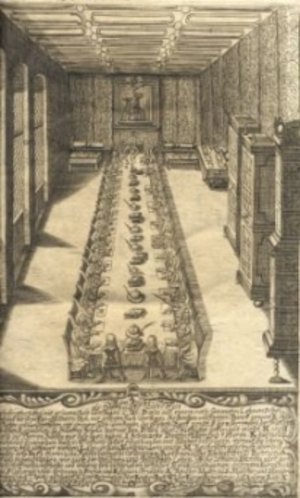
Law and constitution of the Holy Roman Empire of the German Nation were being reassessed in this undertaking based on extensive and previously difficult-to-access source material. From 2007 to 2025, the Göttingen Academy of Sciences and Humanities oversaw the cataloguing of approximately 15 percent of the judicial records of the Imperial Aulic Council preserved in the Haus-, Hof- und Staatsarchiv in Vienna.
Previous legal-historical research had focused primarily on the jurisprudence of the Reichskammergericht (RKG), founded in 1495 and permanently based in Wetzlar from 1693, whose records had been 95 percent catalogued. In contrast, the Aulic Council Reichshofrat, RHR) - meeting at the emperor’s court, usually in Vienna, from the mid-16th century until 1806, and partly cooperating with, partly competing against the Reichskammergericht - had been largely neglected, leaving our understanding of imperial justice incomplete. Both courts, with essentially equal jurisdiction, represented the highest judicial authorities in the Holy Roman Empire. Moreover, the Aulic Council was not only a judicial body but also an administrative and governing organ of the emperor. By the reign of Emperor Rudolf II (1576–1612), the Aulic Council had begun to surpass the Reichskammergericht, dominated by the Imperial Estates, as the leading legal and political force within the Empire.
Within the framework of the project, several thousand files, primarily from the 16th and 17th centuries, were catalogued and made accessible to scholars in ten volumes published by Erich Schmidt Verlag Berlin, as well as online. Over the past years, the project has provided lasting impetus for legal-historical and historical research on the function and significance of the Aulic Council. In terms of volume and density, this collection constitutes one of the most important sources for the legal, constitutional, economic, social, and cultural history of the Holy Roman Empire and its territories.
The project homepage is available here.
The Imperial Aulic Council (RHR) Records
The Aulic Council (Reichshofrat, RHR) exercised, at the latest from 1559 onward, together with the Reichskammergericht (RKG), founded in 1495 and opened in Frankfurt a.M., the highest judicial authority in the Holy Roman Empire of the German Nation. Both courts were as significant in contemporary Europe as the Roman Rota, the Parlement de Paris, or the English King’s Bench.
Nevertheless, in the German-speaking world, legal-historical research long focused primarily on the RKG, which was dominated by the Imperial Estates, while the RHR received comparatively little attention. The reasons for this one-sided treatment are varied. In Austria, the RHR - although usually seated in Vienna - may have been regarded as a tribunal whose connection to the legal history of the country itself was less direct. In Germany, the RKG, dislocated from the imperial court and permanently based in Wetzlar since 1693, was seen as a symbol of the “Teutschen herbrachten Libertät und Freyheit” (German traditional liberty and freedom).
By contrast, the RHR was often opposed because it was allegedly an instrument of the emperor that favored Catholic parties and hindered territorial rulers seeking political independence. According to Karl Siegfried Bader, this led to a near “Perhorreszierung” (systematic denigration) and a loss of reputation for the RHR. Instead, the RKG increasingly became the focus of scholarly interest as a national symbol of integration within the Old Empire. Even today, the highest courts of the Federal Republic of Germany do not see themselves as continuing the tradition of the RHR, but rather that of the RKG.
The RHR only received the scientific attention it deserved decades after 1945. Today, scholars agree that its importance and achievements for the legal and constitutional life of the Old Empire were no less significant than those of the RKG. With essentially equal competence, the RHR, at the latest under Emperor Rudolf II (1576–1612), began to develop into a leading force in legal and political affairs, navigating the tensions between the Empire and the territorial powers and even surpassing the Estate-dominated RKG.
While the approximately 70,000 files of the RKG have been catalogued for more than twenty years and are now 95 percent accessible, the roughly 70,000 files of the RHR, preserved in the Haus-, Hof- und Staatsarchiv in Vienna, remained largely unprocessed. Only from 1999 onward, with financial support from the Volkswagen Foundation, was it possible to catalogue about half of the roughly 5,000 cases comprising the so-called “Old Prague Records” (Alte Prager Akten, APA).
The findings from the APA far exceeded expectations. The catalogued material provides highly informative insights into the activities of the RHR in peripheral regions of the Empire, such as the Netherlands, the Baltics, or Switzerland, as well as in territories that were technically outside its jurisdiction, such as Austria, Bohemia, or Silesia. Moreover, it contains a wealth of petitions addressed to the RHR in unprecedented volume and variety. These files shed new light on the emperor as supreme judge, as supervisory authority over the judiciary of the Empire - including the RKG - and as imperial head to whom many subjects, including merchants, craftsmen, soldiers, peasants, and servants, turned for help regardless of appellate privileges. Predictably, the material also contains numerous cases concerning constitutional and political disputes, including conflicts between territorial estates and their rulers, constitutional disputes of imperial cities, and so-called “subject cases.”
The immense legal-historical and historical value of the surveyed files is further evident in cases beyond constitutional disputes. These include breaches of the Landfrieden, criminal cases such as manslaughter, sexual offenses, assault, robbery, fraud, and slander, as well as cases in inheritance, loans, debts, enforcement, welfare, taxation, customs, labor, and guild matters, and finally disputes in patent, mining, military, art, customs, market, and musical affairs. In addition, long-lost drawings, charters, and other documents submitted to the RHR as evidence by the parties were rediscovered. Overall, the files reflect the lived realities of the Empire as rarely documented in any other historical source.
These promising results called for a further systematic cataloguing of the RHR records. In October 2006, the Federal-State Commission of the Federal Republic of Germany approved funding for the project to be carried out at the Göttingen Academy of Sciences and Humanities. Its goals were to preserve cultural knowledge and make it accessible for humanities and cultural studies research. The project focused on the remaining uncatalogued APA records (approximately 2,500 files) as well as the complete cataloguing of the “Antiqua” (about 9,500 files) and the “Denegata Antiqua” (about 7,000 files). In total, 19,000 files were catalogued, representing roughly 30 percent of the entire “Judicialia” collection.
The inventorying followed the proven principles for cataloguing RKG records, slightly modified to accommodate the specific requirements of the RHR. Accordingly, the cataloguing results provide detailed information on the course of each case, the parties and their lawyers, the subject of the dispute, the evidence - including inventories, accounts, genealogies, maps, plans, and legal opinions - and the size and scope of each file.