

Revision of the manuscripts
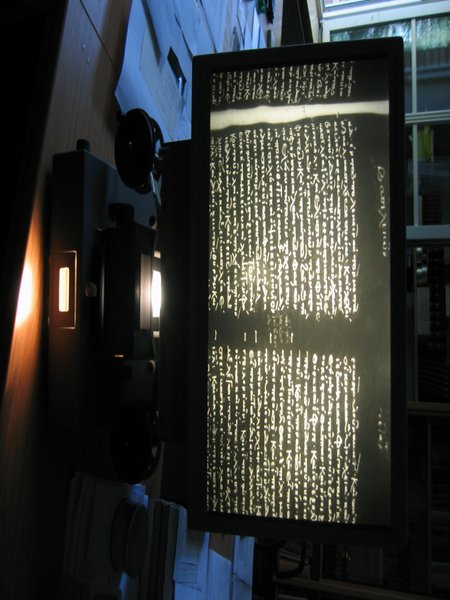
The collations are followed by revisions: all manuscripts are read a second time by a research fellow in collaboration with a colleague (or a very experienced student assistant) to check the accuracy of all the entries in the collation book(s). This time-consuming process is necessary for two reasons:
- First, it helps to eliminate mistakes of collation. Such mistakes cannot be avoided: their number depends not only on the reading ability of the collators, but also on the readability of the manuscripts. These are often hard to decipher because of tachygraphy, mutilation (damage to the page or script, such as fading ink or water damage), or the unsatisfactory state of the photographic reproductions. As does the collation work, the process of revision requires extensive experience in dealing with manuscripts.
- Second, it allows for the rectification or simplification of too complicated or misleading notations in the collation book(s). Seeing that the editors do not usually come into contact with the manuscripts themselves (some occasional cross-checks left aside), the transmission history needs to be recorded in the collation books as comprehensibly and clear as possible. Such clarity is reached by revising the collation books.
In the end, the editors receive the completely revised collation books as the basis for their work, which can start once collation and revision are finished.