
International Septuaginta Summer School
Archive
2014
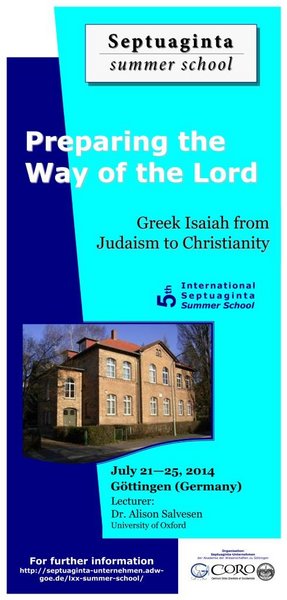
From July 21 to 25, 2014, the 5th International Septuaginta Summer School took place in Göttingen. This year's topic was that of Preparing the Way of the Lord – Greek Isaiah from Judaism to Christianity. The lecturer was Dr. Alison Salvesen, University Research Lecturer at the Faculty of Oriental Studies of the University of Oxford and Supernumerary Fellow in Oriental Studies at Mansfield College (Oxford). Salvesen is an authority on the Oriental translations (Greek, Syriac, Aramaic) of the Hebrew Bible and carries out research on the reception history of these versions during the formative periods of rabbinic Judaism and Christianity; well known is her standard book on Symmachus in the Pentateuch (1991).
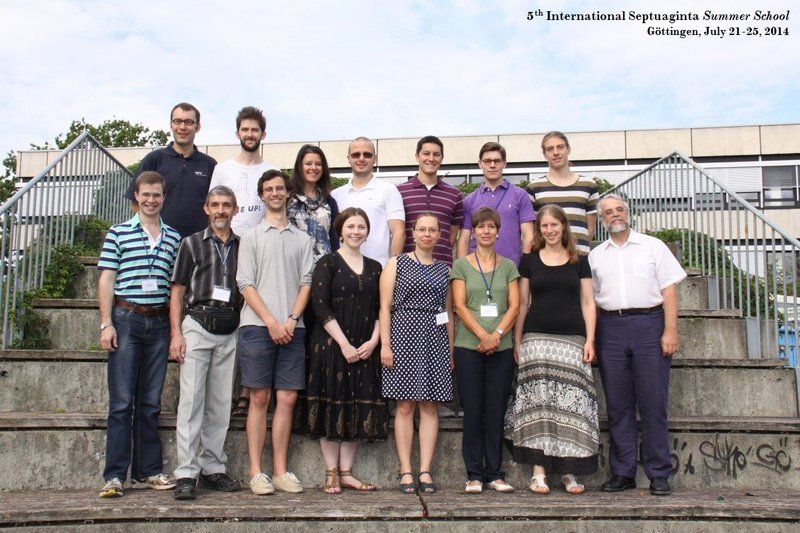
Fourteen participants (hailing from Italy, South Africa, Germany, the Netherlands, Russia, the UK, France and Finland) were offered the possibility to study the Septuagint (that is: the Greek translation of the Hebrew Bible that was carried out in the last three centuries bce and the first century ce) in an intensive yet enjoyable way, and to appreciate this text’s relevance for research on ancient Judaism. More specifically, they investigated the theories concerning the production of LXX Isaiah, as well as the interpretational history of the Greek versions of Isaiah in Judaism and Christianity.
2013
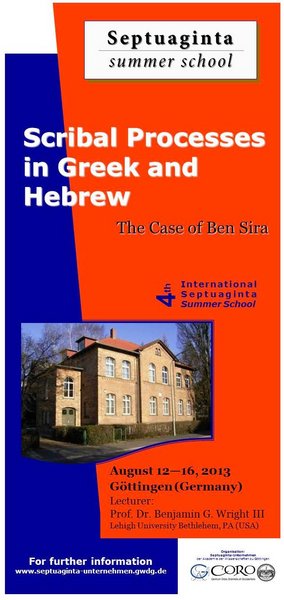
From 12 to 16 August, 2013, the 4th international Septuaginta Summer School took place in Göttingen. This year’s topic was that of Scribal Processes in Greek and Hebrew – The Case of Ben Sira. The lecturer was Prof. Dr. Benjamin G. Wright III (Lehigh University Bethlehem, PA), co-editor of the New English Translation of the Septuagint (NETS) and one of the leading authorities on the book of Ben Sira.
Fourteen participants (hailing from Belgium, Canada, Germany, Israel, Italy, South Africa, Switzerland, the USA, and Zimbabwe) were offered the possibility to study the Septuagint (that is: the Greek translation of the Hebrew Bible that was carried out in the last three centuries bce and the first century ce) in an intensive yet enjoyable way, and to appreciate this text’s relevance for research on ancient Judaism. More specifically, they looked into selected passages from the book of Ben Sira and learned to tackle the thorny issue of the Hebrew source behind the Greek text.
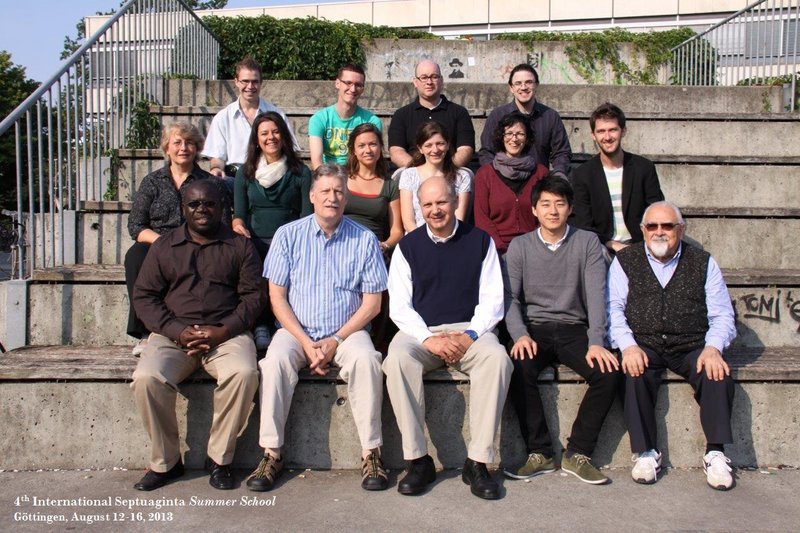
Sessions of academic study alternated with leisure activities and a cultural program, which allowed the participants of the Summer School to get to know the city of Göttingen, its university, and the renowned biblical research projects of the Academy of Sciences and Humanities. Activities included a visit to the municipal cemetery, where some of Göttingen’s greatest rest, such as Paul Wendland, Julius Wellhausen, and Paul Anton de Lagarde. At the Septuaginta-Unternehmen, the students saw how this mammoth research project is carried out and they discovered its extensive manuscript collection.
2012
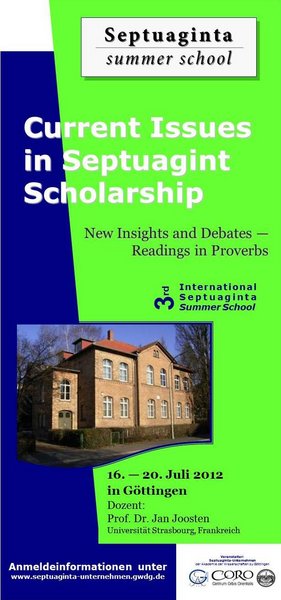
From 16 to 20 July 2012 the 3rd international Septuaginta Summer School took place in Göttingen. The topic was “Current Issues in Septuagint Scholarship – New Insights and Debates – Readings in Proverbs”.
Under the guidance of Jan Joosten, professor of Old Testament at the university of Strasbourg (France) and president of the International Organization for Septuagint and Cognate Studies (IOSCS), participants hailing from Georgia, Italy, USA, Taiwan and other countries closely studied a selection of chapters from the book of Proverbs. In doing so, they focused on text-critical topics, specifically from the perspective of present-day Septuagint scholarship. This acquaintance with some of the hot irons of this field of research brought the participants to appreciate the relevance of the Septuagint for biblical studies in general and the necessity of critical study of this translation.
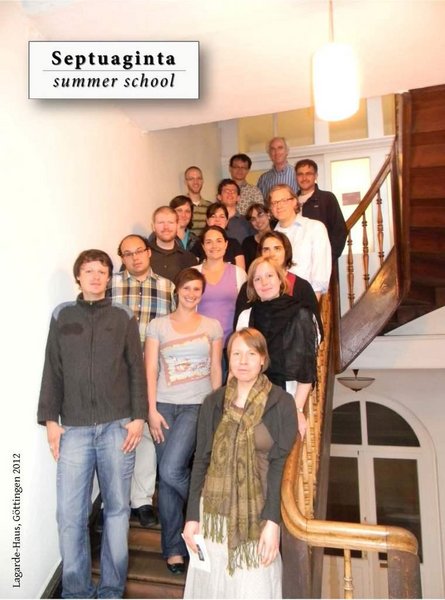
A cultural program enabled the participants to follow the trail of great Göttingen scholars and to gain an impression of the town, its university and above all the rich tradition of the biblical research projects of the Academy of Sciences and Humanities.
2011
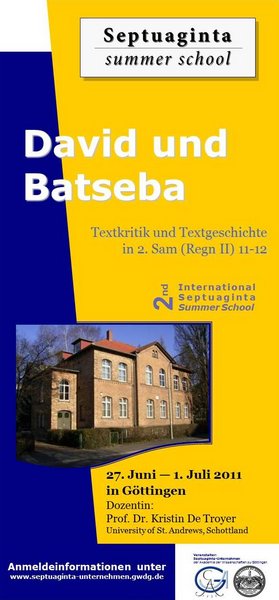
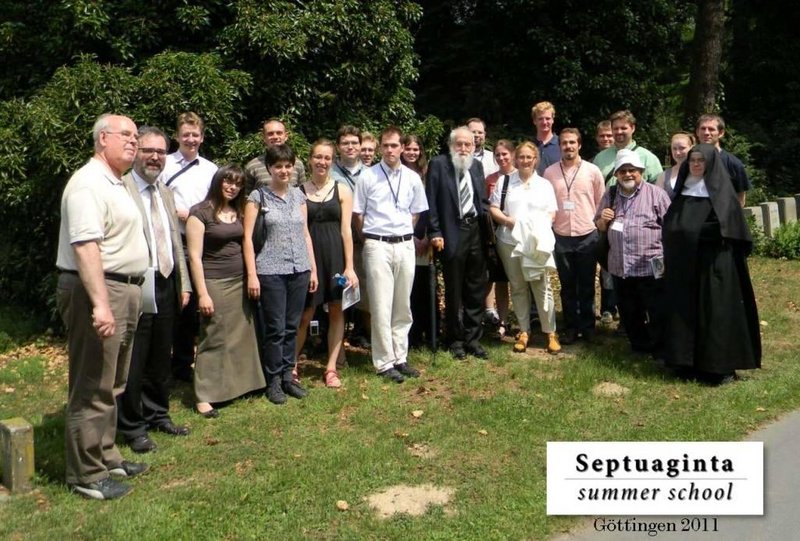
For the 2nd Septuaginta Summer School, which was held from 27 June to 1 July 2011, the concept of the first one was considerably expanded upon. Nineteen participants from South Africa, Greece, Finland and other countries investigated the biblical story of “David and Batseba – Textual Criticism and Text History in 2 Sam (2 Kgdms) 11–12”. Together with the renowned Septuagint scholar Kristin De Troyer (professor at the university of St. Andrews, Scotland) they carried out an in-depth and critical study of the textual developments of the second book of Kingdoms.